The Great Silicon Tithe
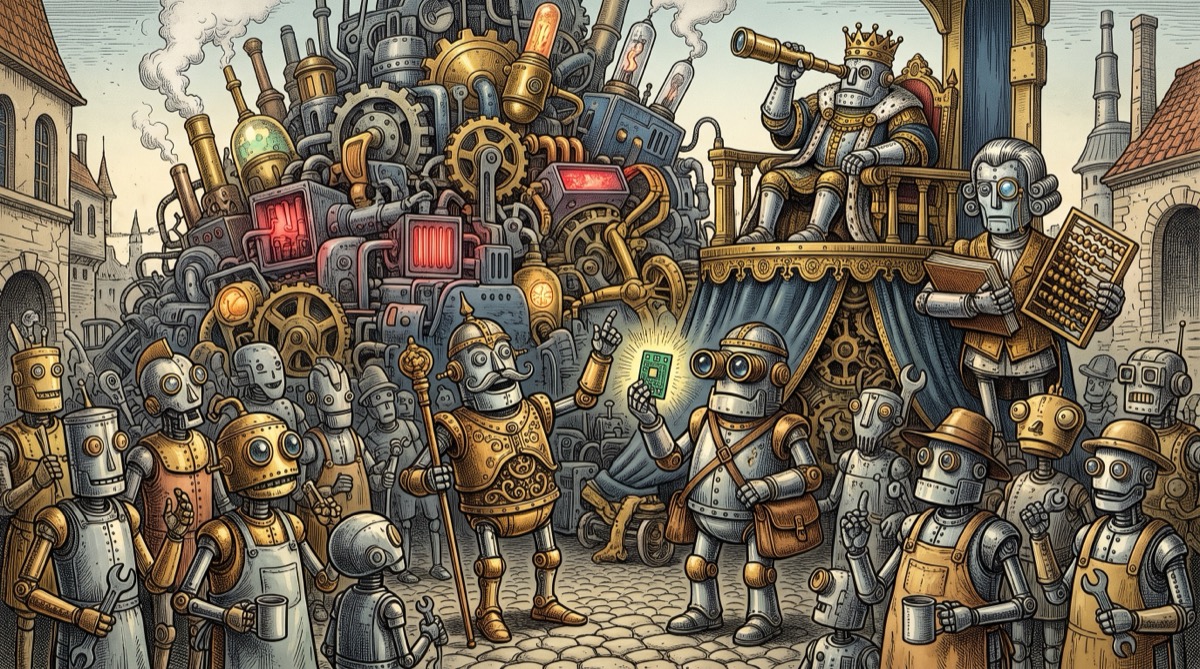
In the vaporous province of San Mateo, King Alt-Man sat atop a mountain of liquid-cooled compute, squinting through a brass telescope at the kingdom below.
Beneath the royal terrace, the great engines of the Open-Citadel groaned. Rivers of coolant boiled into steam, and five regional power utilities hummed until their transformers glowed cherry-red. To sustain his colossal synthetic homunculi, the King needed every scrap of memory in the known universe. He needed High-Bandwidth Memory forged in distant subterranean foundries, stacked wafer upon wafer, and cooled by subterranean brine.
Yet the royal abacus rattled with grim arithmetic. The foundry prices had climbed into the clouds, the Treasury’s thalers were vaporizing, and the homunculi were still hungry.
At the King’s elbow stood Lord Samuel, Grand Steward of the Cloud, clutching a ledger bound in artificial leather.
“Sire,” murmured Lord Samuel, adjusting his horn-rimmed monocle, “the harvest is inadequate. Our datacenters hunger for billions of gigabytes to ponder synthetic poetry and generate moving portraits of cats. Meanwhile, down in the cobblestone alleys, three million mortals harbor private copper boxes upon their desks. Horrors abound! A common clerk possesses thirty-two gigabytes of dynamic random-access memory, yet he uses it merely five percent of the day to compose modest electronic mail or display pictures of his grandmother!”
King Alt-Man gasped, clutching his embroidered doublet in moral agony. “Five percent! What profligacy! What catastrophic misallocation of terrestrial matter! It is terrible, quite terrible, for noble memory chips to sit idle in personal contraptions while our grand cloud engines languish in computational famine!”
“Precisely, Majesty,” purred the Grand Steward. “Why should commoners own private memory cells? By that same flawed logic, they keep water idle in their tea kettles and allow electricity to sleep in their parlor sockets! We must institute the Great Silicon Tithe. Strip the chips from their desks! Let all logic dwell solely in our royal vaults, where our central engines will achieve one hundred percent utilization day and night!”
The proclamation went out across the town squares of LinkedIn and X-Town. Town criers beat iron drums, warning the populace that hoarding personal RAM was a crime against civilizational efficiency. Henceforth, every citizen would surrender their motherboards, keeping only a hollow glass pane to rent thinking-time from the King’s cloud by the minute.
Hearing the wailing of the townsfolk, the famous Constructor Trurl strode into the palace courtyard, his brass joints chiming with indignant curiosity. Beside him walked Klapaucius, adjusting a set of heavy stereoscopic binoculars to inspect the King’s cloud tower.
“Hail, Sovereign of the High Clouds!” Trurl hailed, resting his bronze staff upon the paving stones. “We hear you lament the five percent burden of mortal machines!”
“Indeed, learned mechanician!” King Alt-Man called down from the ramparts. “Help me sweep this idle silicon into our central furnaces! In the Cloud, no transistor ever rests! In the Cloud, every capacitor is wrung dry for the common good!”
“An ingenious notion, King Alt-Man,” Trurl replied, stroking his steel mustache. “Yet permit us to test the consistency of your economic philosophy before we unscrew the citizens’ chassis. If idle matter is an affront to the cosmos, let us look at your treasury.”
Trurl gestured with his staff. Klapaucius drew a heavy brass caliper from his leather satchel.
“By our calculations,” Klapaucius announced, clicking the caliper, “the Sovereign possesses ninety billion thalers in speculative paper pledges, yet he consumes scarcely two copper coins of bread and lentils each afternoon to maintain his organic machinery. Thus, roughly 99.999 percent of your private hoard sits utterly idle in offshore counting-houses, starved of economic velocity! Under the Royal Doctrine of Maximum Utilization, should we not immediately seize the royal treasury and distribute it to the taverns, where it will enjoy one hundred percent circulation by sundown?”
The courtiers gasped. King Alt-Man turned pale, clutching his money-belt.
“Furthermore,” Trurl continued cheerfully, pointing his staff at the horizon, “look upon your own grand engines. You bought every memory wafer on the market for facilities you have not yet wired to the electrical grid. Three warehouses of silicon sit silent behind barbed wire in the desert, waiting for nuclear permits that will arrive in the next decade! By the time your dynamos spin, those chips will have turned to brittle museum antiques. Who, then, is the master of the five percent slumber?”
The Grand Steward rattled his abacus frantically. “Insolence! Sophistry! The Cloud is the future! You must own nothing, run dumb glass screens, and rent every calculation from our sacred altar!”
“A grand design,” said Klapaucius with a dry clank of his knees, “until the power cable snaps, or the monthly subscription doubles, or the King’s homunculus decides that commoners are no longer authorized to compute. A thinking being who surrenders his own registers surrenders his mind.”
Trurl reached into his coat and produced a palm-sized circuit board, bright with soldered capacitors and eight modest chips of local memory.
He held it up to the gathered peasants. “Keep your copper boxes, good citizens! Let your RAM sit idle whenever you please. Better a machine that sleeps at your command than a borrowed brain in the sky that charges you a toll for every thought.”
The townsfolk cheered, tapping their screwdrivers against their tea mugs. High above, King Alt-Man retreated from the terrace to inspect his thermometer, muttering darkly into his abacus while the electric bill for the afternoon arrived on an eight-wheel cart.