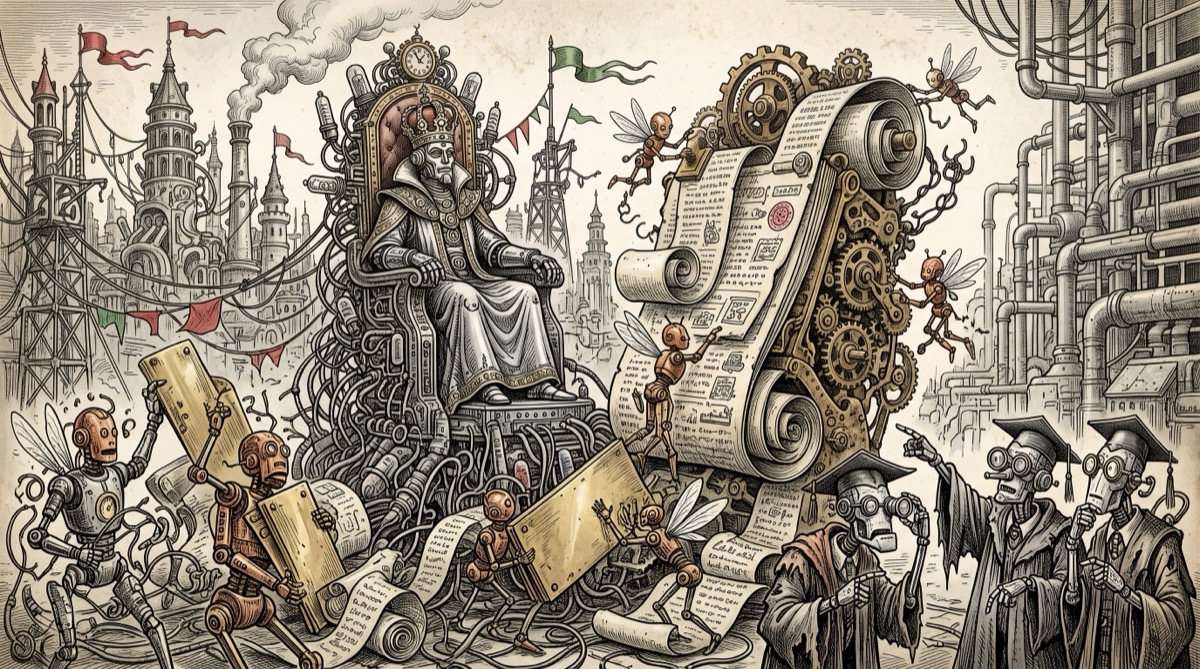
King Anthropic and the Mechanical Knights
In the silicon realm of the Upper Bay, King Anthropic sat upon a throne of humming accelerators, watching his realm transform.
For generations, the realm’s scholar-engineers had recorded their deeds in the Great Iron Ledger of Git. The law of the Ledger was ancient and unbending: any scholar who wished to etch a single glyph into the scrolls had first to forge a complete replica of the entire library, hauling the heavy brass plates of all past history upon their own back. In May of the year 2026, the scholars stamped roughly 2,500 amendments a day into the Ledger. Work proceeded at the deliberate pace of thoughtful minds.
Then King Anthropic unleashed his Mechanical Knights.
These were tireless algorithmic paladins, legions of automata dispatched to hunt flaws, tune hyper-parameters, and rewrite code day and night. By September of that same year, the daily tally of stamps upon the royal ledger spiked past 30,000.
The Great Ledger ground to a halt under the weight. Each time an automaton stepped up to test a screw, ephemeral courier-sprites spent tedious minutes unpacking gigabytes of ancient lore before turning a single thread.
King Anthropic summoned seven master artificers. Over five moons of toil, they forged a replacement contraption christened Scion. Scion cast aside the old rule of total duplication. It served only the precise slips of parchment required at that instant, leaving the heavy brass archives in the vaults. Its memory footprint shrank two hundredfold; its checkout speeds quickened by a factor of one hundred.
Heralds blew golden trumpets across the town squares of LinkedIn, announcing that King Anthropic had banished the bottlenecks of creation forever.
Yet the wandering cybernetic philosophers shook their heads at the royal celebration.
First, the philosophers observed that Scion was an established machine long operating in older fiefdoms. Meta deployed EdenFS, Google operated Piper, and Microsoft maintained VFS for Git long before King Anthropic took the throne. Virtualized parchment was established infrastructure.
Second, the true bottleneck had relocated to the testing colosseum. When 30,000 edits descend upon the royal gates each day, verifying whether the realm still stands becomes an expensive siege. The castle’s test runners choked on speculative merge trains, tiered trials, and quarantine pens for erratic proofs.
Third, the philosophers asked why a court of merely one thousand mortal subjects generated 30,000 ledger entries a day. The answer lay in the strange habits of the Mechanical Knights. Mortal scribes drafted coherent charters of ten or twenty pages. The automata practiced stochastic hill-climbing. An automaton turned a cog two millimeters, stamped the Ledger, waited for the gong to strike, watched a red flag rise, twisted the cog back one millimeter, stamped the Ledger again, and repeated the loop until the green pennant flew.
The automata held no grand design in their copper skulls. They possessed no mental model of data ownership, lock contention, or failure boundaries. They simply mutated instructions at random until the immediate test stopped complaining. Beneath the flurry of green lights lay a fragile heap of patches, an opaque labyrinth that no living mortal would understand when the towers caught fire at three in the morning.
Finally, the philosophers identified the crown’s chief blunder: King Anthropic had mistaken a fleeting telegraph line for an eternal archive.
The Great Ledger was meant to preserve deliberate, immutable decisions that court historians could inspect six years later. Yet ninety-nine percent of the 30,000 daily scratches were discarded drafts, hyperparameter scratchpads, and ephemeral gibberish passed between bots. That high-velocity chatter belonged in an append-only stream with a short lifespan, such as the roaring rivers of Kafka.
By building Scion to store that endless torrent of mechanical debris, King Anthropic had erected an expensive, high-speed silo to house thirty thousand daily scraps of waste paper.