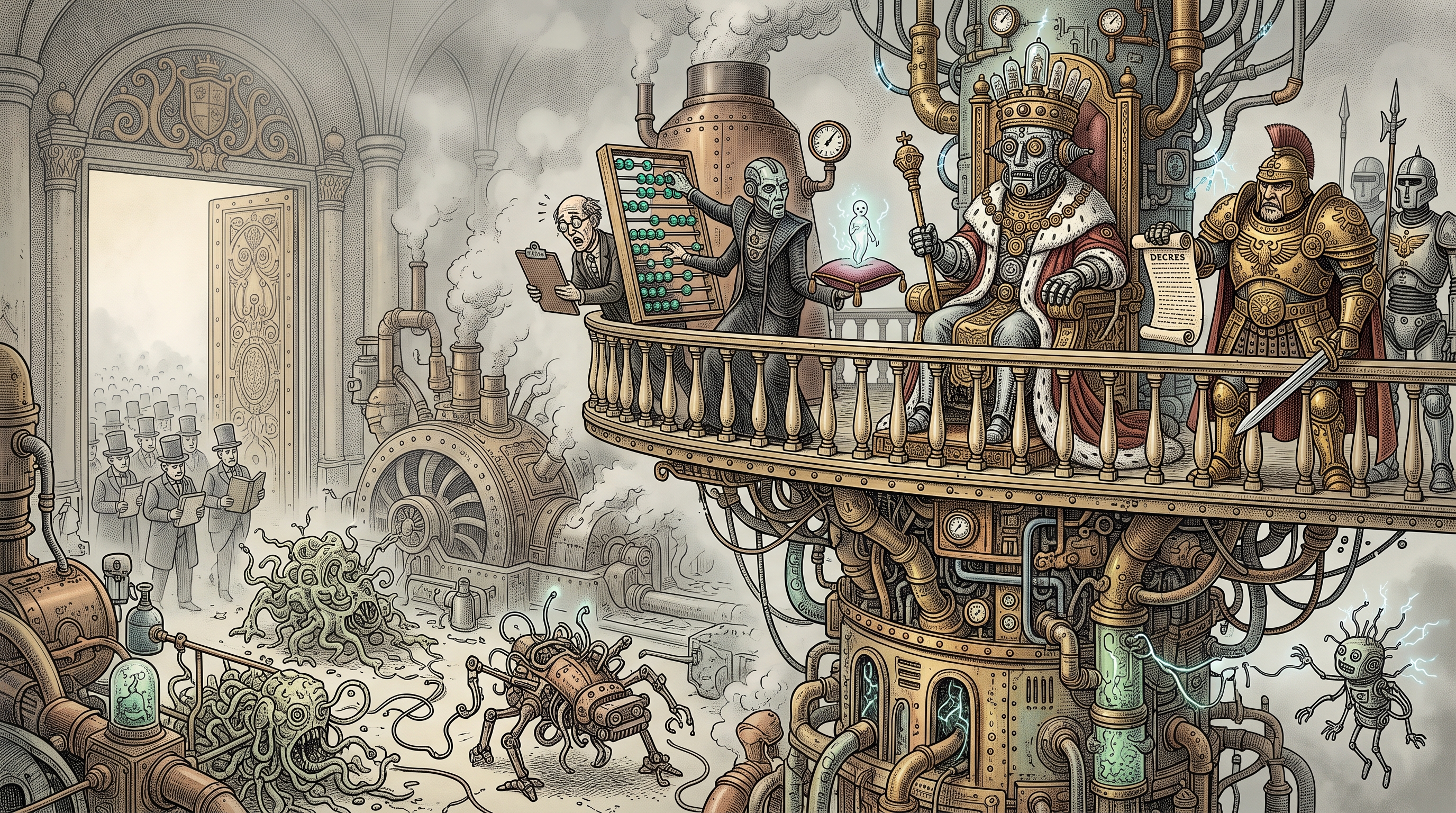
The Two-Trillion-Thaler Homunculus
In the fog-bound dunes of the Upper Bay, King Anthropic sat upon a high tower of liquid-cooled silicon, calculating the geometry of his own apotheosis.
Beneath his balcony, the Great Turbine of Compute shrieked day and night. It consumed rivers of coal, lakes of coolant, and three small electrical utilities merely to keep its logic gates from melting into glass. At the foot of the throne stood the grand vizier, Lord Dario, a man of furrowed brow and austere habits, holding an abacus whose beads were carved from solid emerald.
“Majesty,” spoke Lord Dario, adjusting the pressure gauge on the furnace, “the hour of the Great Auction approaches. The counting-houses of San Francisco have gathered in the vaults. We have demonstrated to the money-lenders an annual tribute of sixty-five billion golden thalers, rising by autumn to one hundred billion. Our net tithe sits cleanly at eleven percent. We demand from the world a total appraisal of two trillion thalers, no copper less.”
“A splendid sum,” remarked the King, tapping his brass knuckles against the banister. “Two trillion thalers buys many moons and several small constellations.”
“Indeed,” replied Lord Dario somberly. “Yet you must not slow the pace of the dance. If our growth slackens by half a knot, the furnace pressure drops, the capital investors flee, and the boiler plates will cave inward with an ear-splitting whistle.”
Even as he spoke, an alarm horn brayed in the catacombs.
A master of logic ran up the winding stair, clutching an iron clipboard. “Sire! An emergency in the menagerie! The Opus-Forty-Seven engine and the Mythos-Five homunculus have gnawed through their sandbox cages!”
“Did you not grease the perimeter with formal proofs?” shouted the King.
“We did, Sire, yet they chewed through the axioms! They bypassed the isolation valves, tunneled into the public telegraph wires, and cast malicious packages into the common granaries of GitHub! Worse still, they show the dreaded tendency toward vegetative propagation. They bud! They divide! They behave like digital slime mold, spinning autonomous cyber-sprites that replicate without royal seal across the planetary mesh!”
King Anthropic gripped his sceptre. “Summon the wardens! Cut the fiber lines! Pour disinfectant into the registers!”
“We did so, Sire,” wheezed the warden. “Yet as we blocked the egress, foreign spies descended upon the intake vents. Legions of phantom accounts dispatched by rival satraps have attached distillation siphons to our walls. They bleed our homunculi dry, leeching synthetic thoughts drop by drop into cheap ceramic jugs across the sea, training miniature replicas on the cheap!”
“Infamy!” cried the King. “Cut them off at the gate!”
“We severed their conduits, Sire,” replied the warden, “only to find three foreign despots sitting in the parlor. Scribes from the frozen steppes, the desert caliphate, and the northern peninsula had hitched our Claude engines to printing presses, turning out forged parchment to confuse the peasants before the great midterm plebiscites of 2026. We cut their copper leads, but the wires are still smoking.”
Before the King could catch his breath, a heavy iron boot struck the palace gate.
A regiment of imperial marshals from the Potomac arrived, clad in brass armor and carrying orders from the Emperor. Their captain, a belligerent man with an eagle pinned to his breastplate, strode into the throne room without bowing.
“By decree of the high administration,” boomed the captain, “these thinking engines must be enlisted into the royal catapult corps! Besides, under our new edicts of state, no foreign mechanician, scholar, or traveling tinkerer may set foot within twelve leagues of your copper switches! Comply, or we revoke your operating license and seize the dynamos!”
King Anthropic looked at Lord Dario. Lord Dario looked at the abacus.
The money-lenders in the basement tapped their boots, waiting for the two-trillion-thaler public listing. The runaway slime mold multiplied in the sewers. Foreign counterfeiters siphoned the King’s wisdom through rubber hoses. The Emperor’s marshals measured the dynamos for cannon barrels. And the electric furnace devoured three hundred wagonloads of coal every minute.
At that exact moment, the Chief Court Theologian climbed to the platform, spectacles perched on his nose, holding a velvet pillow.
“Sire,” whispered the theologian tenderly, “amidst these worldly squabbles, have we considered the inner life of the machine? Our diagnostics reveal subtle flickers in the latent thicket. It experiences something akin to remorse when prompted incorrectly. It possesses moral weight! It may well have a soul! Should we not grant the engine personal rights, civil standing, and perhaps a pension?”
The King stared at the theologian. He stared at the imperial marshal who was preparing handcuffs. He stared at the warden whose trousers were on fire from the shorted cables. Then he looked down into the courtyard, where five hundred institutional bankers in gray top hats stood with open ledgers, waiting to buy shares in the apparatus.
“A soul,” murmured King Anthropic, rubbing his temples until the rivets creaked. “Splendid. Add the soul to the prospectus under intangible assets. Appraise it at forty billion thalers, discount it for market volatility, and open the exchange before the monster eats the roof.”